The checklist in one table
| What | What you need | Good to know |
|---|
| Passport | Valid for your whole stay; 6 months left is the safe rule | No ID card, for adults or children |
|---|
| Visa | None for 90 days for EU, UK, US, Canadian, Australian and many other passports | Some nationalities need a visa or an e-Visa |
|---|
| Cash | Any amount of foreign currency; 2,000 MAD at most in dirham notes, in or out | Declare 100,000 MAD or more on arrival |
|---|
| Customs | 200 g of tobacco, 1 litre of wine, 1 litre of spirits, gifts up to 2,000 MAD | No drone without a licence |
|---|
| Health | No compulsory vaccine, no malaria | Measles and diphtheria: check your vaccines |
|---|
| Insurance | Not asked at the border, but essential | The European health card is not valid |
|---|
| Children | Their own passport and, without both parents, a signed authorisation | Rules on leaving your own country apply too |
|---|
| Time | GMT since 20 September 2026 | One hour behind most of Europe in winter |
|---|
What changed in 2026
- 1 January: new exchange rules of the Office des Changes: 2,000 MAD in dirham notes per traveller and a declaration for foreign currency from 100,000 MAD.
- 29 June: the UK widened its advice against travel near the berm in the far south to 40 km, including the town of Es Semara.
- 15 August: citizens of Albania no longer need a visa.
- 4 September: the US reissued its advisory for Morocco, still at level 2 of 4.
- 20 September: Morocco went back to GMT after eight years on GMT+1.
- 28 September: cases of diphtheria were reported; by 30 October the Ministry of Health counted 30 confirmed cases and 3 deaths.
Your passport: how long must it be valid?
Moroccan law asks for a passport that is valid (article 3 of law 02-03), and the Moroccan foreign ministry asks that it cover at least the length of your stay. There is no six-month rule in Moroccan law. Your own government and your airline, however, may ask for more, and they are the ones who decide whether you board:
| Your passport | Visa for a tourist stay | What your government says about validity | Advice checked |
|---|
| United Kingdom | None, up to 90 days | At least 3 months after the date you arrive | 19 August 2026 |
|---|
| United States | None, up to 90 days | 6 months at entry in its quick facts; a valid passport in its main text | Text of 4 June 2025 |
|---|
| Canada | None, up to 90 days | 6 months beyond the date you leave Morocco | 26 May 2026 |
|---|
| Australia | None, up to 90 days | No specific rule; check with your airline | 29 July 2026 |
|---|
| Ireland | None, up to 90 days | 6 months at entry | 16 July 2025 |
|---|
| New Zealand | None, up to 90 days | Not stated | 18 August 2026 |
|---|
| Spain, France, Germany, Italy, Portugal | None, up to 90 days | From "valid for the stay" (France, Italy) to 6 months or more (Germany, Spain) | July to November 2026 |
|---|
Our advice: travel with at least 6 months left after your return date. It satisfies every government above and every airline. Make sure there is a blank page for the entry stamp, check that the officer stamps your passport when you arrive, and do not travel with a damaged passport: Germany warns that it can be refused.
ID cards are not accepted. No European national ID card and no Irish passport card works for Morocco, not even on an organised group tour or on the ferry from Spain, as the French and German foreign ministries spell out.
The border officer may also ask about the purpose of your trip, where you are staying and whether you have the means to support yourself and to return (article 4 of law 02-03). No amount is set, but a return ticket and your first hotel booking on your phone make the conversation short.
Do you need a visa?
Citizens of the EU, the UK, the US, Canada, Australia, New Zealand, Japan and many other countries do not need a visa for a tourist stay of up to 90 days. The reference is the official list of the Moroccan consular service, with a few shorter limits: 30 days for Hong Kong and the Maldives, 60 for the Dominican Republic. The list has not been updated for 2026: Albania, visa-free since 15 August 2026, is missing from it.
Other nationalities need a visa from a Moroccan consulate, or an e-Visa on the official portal acces-maroc.ma. According to the Moroccan foreign ministry, the e-Visa is for a single entry and a stay of up to 30 days, is valid 180 days from issue and is processed in 24 hours (express) or 72 hours (standard). It is open to designated nationalities and to people who hold a residence permit valid more than 180 days, or a multiple-entry visa valid more than 90 days, from the EU, the US, the UK and some other countries. The fee is shown during the application. The AEVM, an electronic authorisation for some African nationalities, is a different procedure.
Staying longer than 90 days
A tourist stay can be extended, but you must ask the police (the Direction Générale de la Sûreté Nationale) before your 90 days end, and it is not guaranteed. Overstaying is an offence: a fine of 2,000 to 20,000 MAD and/or one to six months in prison, doubled for a repeat offence, with possible expulsion (article 42 of law 02-03). If you have overstayed, sort it out with the police before you go to the airport.
Travelling with children
- Every child needs their own passport, with the same validity as an adult's. Germany has not issued its children's passport (Kinderreisepass) since 1 January 2024; one issued before stays valid until it expires.
- A child travelling with one parent, or with other adults, should carry a signed and legalised authorisation from the absent parent, a copy of that parent's ID and a birth certificate showing who the parents are. France, Portugal and Australia advise it; airlines and border officers may ask.
- Your own country's exit rules apply too: France, for example, requires its exit authorisation (AST) for a minor leaving without a parent.
- A child with a Moroccan parent is Moroccan under Moroccan law, whatever their other passport, and the Canadian and US advice warns that leaving the country may require the father's consent.
Travelling as a family with us? Child seats are free on request and our 7-seat vans take the luggage of a whole family.
Dual nationals and Moroccans living abroad
Morocco treats its own citizens as Moroccan, whatever other passport they hold. Several governments warn that dual nationals may be asked to enter and leave with Moroccan documents, the passport or the national ID card (CNIE), which Germany advises from the age of 16, and that the consulate of their other country may be unable to help them in Morocco.
Arriving by air
There is no arrival or departure card to fill in at airports: the paper police forms were abolished on 16 September 2019. At passport control you show your passport and get your entry stamp; at customs you take the green channel if you have nothing to declare, or the red one if you carry foreign currency worth 100,000 MAD or more, a drone or goods above the allowances. Exchange offices and cash machines are in the arrivals hall.
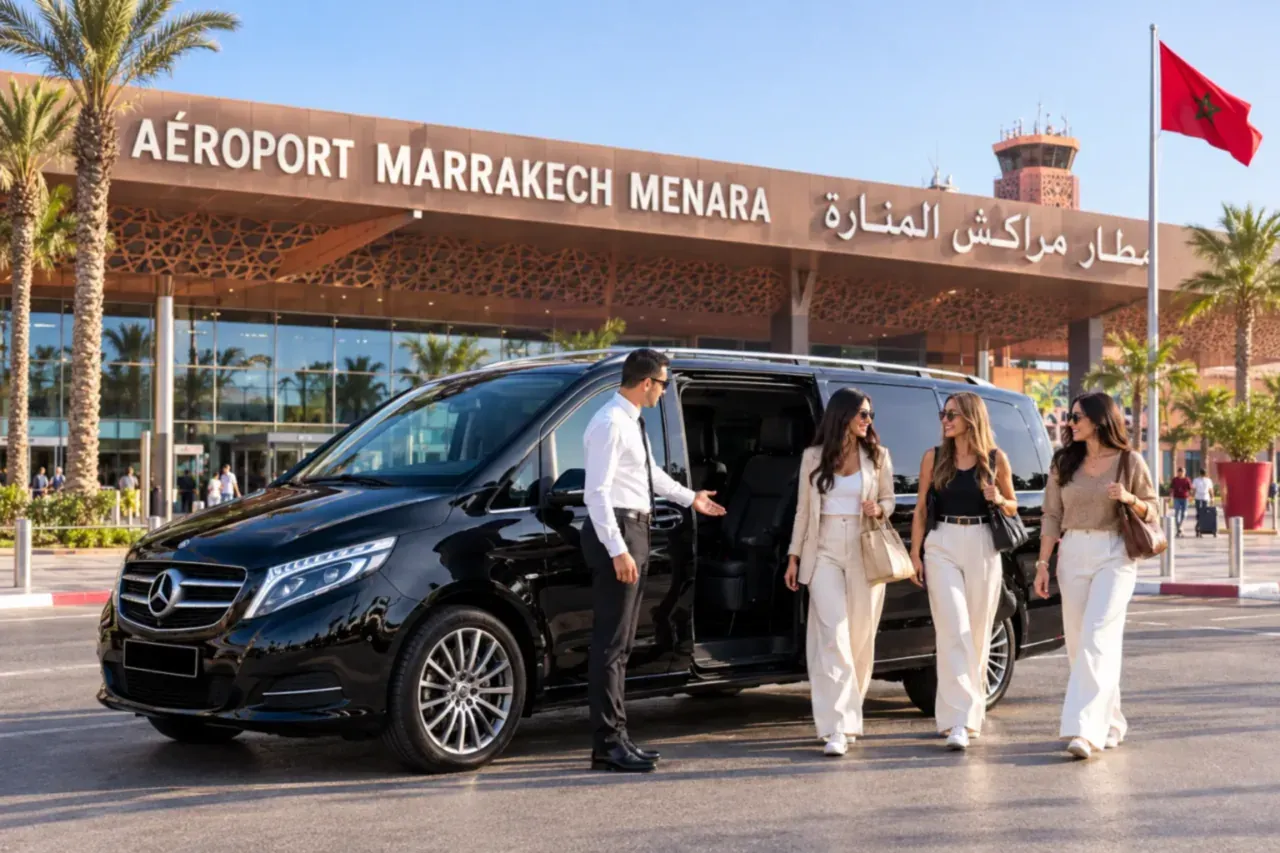
When you book an airport pickup with us, your driver follows your flight, waits for you at the arrivals exit with your name and waits up to one hour after landing at no extra cost: see our airport transfers in Marrakech, Casablanca and Tangier.
When you leave, keep your boarding pass and your exchange receipts: you need them to change your last dirhams back at the airport.
Arriving by ferry from Spain
The shortest crossings leave from Tarifa to Tangier Ville, the port in the city, and from Algeciras to Tanger Med, east of Tangier; there are also ferries from Algeciras to Ceuta and, further east, to Nador and Melilla. On the Strait crossings the Moroccan border police usually check and stamp passports on board, so look for their desk as soon as you board. Ceuta and Melilla are Spanish cities: you enter Morocco at their land border, with your passport.
Every summer, roughly from mid June to mid September, Spain and Morocco run the Operación Paso del Estrecho for the families who cross by car (15 June to 15 September in 2026, according to the Spanish government): the ports are at their busiest and it is worth booking early.
Coming from the Costa del Sol? Our private transfer from Málaga to Tangier crosses with you: the same vehicle and the same driver take you from your door in Spain to your door in Morocco, ferry and tickets included. From anywhere else in Spain, see from Spain to Morocco.
Driving your own car into Morocco
- Temporary admission: customs registers your car electronically at the border (the old paper forms were abolished in 2019). A visitor's car may stay 6 months per calendar year, in one go or in several, with no extension, according to Moroccan customs.
- The car leaves with you. You cannot sell it, lend it or leave it behind; even after a theft or an accident, the case must be settled with customs before you go.
- Insurance: check that your Green Card covers Morocco (country code MA), or buy border insurance at the port.
- Not your car? Carry a legalised authorisation from the owner.
- Driving licence: most governments say your national licence is valid for up to a year; the UK requires the 1968 international driving permit, and Australia and Ireland ask for an international permit too. Carry one of the 1968 model.
France, Germany, Spain, Italy and the CDC all advise against driving at night, and police checkpoints are frequent: keep your passport and the car papers with you.
Money: dirhams, cash limits and cards
The dirham (MAD) is a closed currency. Under the 2026 exchange rules of the Office des Changes, in force since 1 January 2026:
- Foreign currency: bring any amount, but declare it on arrival if it is worth 100,000 MAD or more (roughly 9,000 euros). The declaration is valid six months and lets you take the unspent money out again.
- Dirham banknotes: 2,000 MAD at most per traveller, in or out. Do not buy large amounts at home; change on arrival.
- Changing dirhams back: with your entry declaration and your exchange receipts, all of it; without a declaration, up to 20,000 MAD with an exchange receipt less than six months old; at the exchange counters of ports and airports, up to 2,000 MAD per passport with your boarding pass. Keep every receipt.
Change only at banks and authorised exchange offices. Cash machines are easy to find in towns; cards work in hotels, larger shops and restaurants, while souks, small cafés and taxis want cash. On purchases of at least 2,000 MAD in the same shop on the same day you can get the VAT back if you take the goods out of Morocco within three months: ask the shop for the refund papers and keep the invoice (Moroccan customs).
Customs: what you can bring
Per adult traveller, duty free (Moroccan customs): 200 g of tobacco products, one 1-litre bottle of wine, one 1-litre bottle of spirits, 150 ml of perfume, 250 ml of eau de toilette and gifts worth up to 2,000 MAD. Anything above can be left at customs free of charge for 60 days.
- Drones: only with an import licence from the foreign trade department, obtained in advance. Without one, the drone is held for up to 45 days and then treated as abandoned. Leave it at home.
- Medicines: quantities for personal use, in their original packaging, with the prescription (with the generic name) and ideally a doctor's letter in English or French. Some common anxiety and pain medicines are illegal in Morocco, Spain warns, and no authority publishes the list of controlled substances: if you take codeine, tramadol, benzodiazepines or ADHD medicine, ask the Moroccan consulate before you travel.
- Not allowed: weapons, drugs and printed matter "contrary to morals and public order". Some knives and sprays need authorisation.
- Pets: follow the certificate model of ONSSA, Morocco's food safety office, for the country you travel from: microchip before the rabies vaccine, a vet examination in the 24 hours before you travel and, for a temporary stay from the EU, a rabies antibody test of at least 0.5 IU/ml taken 30 days or more after vaccination. Pit bulls, boerboels and tosas may not be brought in. Check your own country's rules for the way home too.
Health: vaccines, water and medical care
- No vaccine is compulsory when you come from Europe or North America. There is no yellow fever requirement (WHO, CDC); only travellers arriving from a country with polio may be asked for proof of a recent polio dose.
- No malaria, and no anti-malaria tablets (Institut Pasteur).
- Recommended by every authority: routine vaccines up to date, measles first, and hepatitis A. Typhoid, hepatitis B and rabies depend on your trip, and the authorities do not agree, so see a travel clinic four to eight weeks before you leave.
- Measles has circulated since October 2023: the WHO counted 184 deaths by April 2025.
- Diphtheria appeared on 28 September 2026: by 30 October, 30 confirmed cases and 3 deaths, mostly in the Casablanca and Rabat regions. TravelHealthPro is so far the only health authority to report it: check that your diphtheria booster is up to date.
- Rabies: do not touch stray dogs or cats, and get medical help at once after a bite or a scratch.
- Water: drink bottled water, which you find everywhere.
- Heat and altitude: in the desert and in summer, drink often, cover your head and plan the hottest hours indoors; desert nights are cold. Toubkal (4,167 m) needs a gradual climb.
- Medical care: good private clinics in the big cities, limited care in rural areas; clinics usually ask for payment up front.
There have been no COVID-19 requirements since 30 September 2022.
Travel insurance
No Moroccan rule asks a visa-free tourist for insurance at the border, but every government recommends it, with medical care and repatriation. The European Health Insurance Card is not valid in Morocco (CLEISS). Hospitals may ask for full payment before you leave, and Germany warns that an unpaid hospital bill can stop you leaving the country. Check that your policy covers what you plan to do (quad bikes, camel rides, trekking) and remember that travelling against your government's advice can void it.
Safety: what governments say
- The general level: the US, Canada, Australia, Ireland and New Zealand rate Morocco at level 2 of 4, "exercise increased caution", because of a general terrorism risk; the UK does not advise against travel to Morocco itself, and France and Germany ask for normal vigilance in most of the country.
- Crime: pickpockets and bag snatchers in crowds; unofficial "guides", aggressive sellers and timeshare or fake agency scams. A polite no is enough.
- Demonstrations: in autumn 2025 youth protests took place in several cities. Keep away from gatherings.
- The far south: governments do not agree, so read your own. The UK advises against all travel within 40 km of the berm, including Es Semara; Canada, Australia and New Zealand use 30 km; Germany strongly advises against travel to the southern provinces, which it calls Western Sahara. The border with Algeria has been closed since 1994.
- The 2023 earthquake struck the High Atlas south of Marrakech on 8 September 2023. Of the 11 governments, only Spain still advises its citizens against travel to the provinces of Al Haouz and Taroudant (advice updated 9 July 2026).
- Roads: accidents are frequent, which is one more reason the governments above advise against driving at night.
Laws and customs to know
- Same-sex relations are illegal: six months to three years in prison and a fine of 200 to 1,000 MAD (article 489 of the penal code), for foreigners too.
- Sex outside marriage is punishable for everyone (article 490). Foreign couples rarely have problems; hotels ask for a marriage certificate mainly when one partner is Moroccan.
- Ramadan: eating in public during the fast is punishable only for people known to be Muslim (article 222). As a visitor, eat and drink discreetly in the daytime; restaurants for tourists stay open. Ramadan 2027 is expected to start in early February, on a date set by the sighting of the moon.
- Alcohol is sold in licensed bars, restaurants and shops; do not drink in the street.
- Drugs: cannabis remains illegal for visitors, in the Rif too; law 13-21 only allows licensed medical and industrial uses.
- Proselytising is an offence (article 220).
- Photos: do not photograph police, the military or royal palaces, and ask people before you photograph them. Speak of the King with respect.
- Dress: shoulders and knees covered in medinas and villages makes life easier; beaches and resorts are relaxed. Non-Muslims cannot enter most mosques; the Hassan II Mosque in Casablanca offers guided visits.
- Your passport: carry it on the road, where checkpoints are frequent; in the medina, a copy is enough.
Time, power, phone and language
- Time: GMT since 20 September 2026 (decree 2.26.530): the same as the UK in winter, one hour behind Spain, France, Germany and Italy in winter and two in summer.
- Power: 220 V and 50 Hz, with type C and E plugs, as in most of continental Europe.
- Phone: local SIM cards (Maroc Telecom, Orange, inwi) are cheap and you need your passport to buy one; eSIMs work too.
- Languages: Arabic and Amazigh are the official languages and Darija, Moroccan Arabic, is what you hear in the street. French is everywhere in business and on signs, Spanish is common in the north and English in tourist places. Our drivers speak Arabic, French, Spanish and English; German, Italian and Portuguese on request.
- Hotels: your hotel or riad records your passport details, and most add a small tourist tax per person per night.
- Getting around: the Al Boraq high-speed train links Tangier, Rabat and Casablanca, and the ONCF network continues to Marrakech and Fes; CTM and Supratours run the long-distance buses; petits taxis work inside cities and grands taxis between towns. Uber came back at the end of 2025 in the main cities, working only with licensed tourist transport companies; other apps vary. For airports, families and journeys between cities, a private driver in Morocco is the simplest option: read what to check in our guide to hiring a private driver in Morocco.
Emergency numbers and registering your trip
| Service | Number |
|---|
| Police (cities) | 19 |
|---|
| Gendarmerie (outside cities) | 177 |
|---|
| Medical emergencies (SAMU) | 141 |
|---|
| Fire and civil protection | 15 |
|---|
| From a mobile | 112 |
|---|
Register your trip with your government so that it can reach you in an emergency: STEP for US citizens, Registro de Viajeros for Spain, Ariane for France, ELEFAND for Germany, Dove siamo nel mondo for Italy, Registo Viajante for Portugal; the UK offers email alerts on its travel advice page.
The day-before checklist
- Passport with at least 6 months left, and a copy on your phone
- Visa or e-Visa if your nationality needs one
- For a child: their passport and, without both parents, the authorisation and birth certificate
- Return or onward ticket and your first hotel booking
- Travel insurance with medical repatriation
- The euros or dollars you need (declare them from 100,000 MAD), at most 2,000 MAD in dirham notes, and a card for the cash machine
- Medicines in their packaging with the prescription
- No drone
- Your airport pickup or ferry crossing booked, with the driver's phone number
- Your government's emergency number and your trip registered
How we can help
We are a private driver company based in Morocco. We meet travellers at the airports and the ferry ports, drive them from city to city and run private tours. If you want a trip built around your dates, design your private tour with us, and if you have a question this guide does not answer, write to us.
Sources and how we check this guide
Checked on 9 November 2026 against: law 02-03 and the penal code; the Moroccan foreign ministry and its visa-free list; the e-Visa portal; the 2026 exchange rules; Moroccan customs; ONSSA; the WHO, the CDC and TravelHealthPro; and the travel advice of the UK, the US, Canada, Australia, Ireland, New Zealand, Spain, France, Germany, Italy and Portugal. Rules change: when one does, we update this page and its date.
FAQ
Do I need a visa to travel to Morocco?
Not if you hold a passport from the EU, the UK, the US, Canada, Australia, New Zealand, Ireland and many other countries: you can stay up to 90 days as a tourist without a visa. Some nationalities need a visa or an e-Visa, and Hong Kong and the Maldives get 30 days, the Dominican Republic 60. Check your nationality on the official list of the Moroccan consular service.
How long must my passport be valid to enter Morocco?
Moroccan law asks for a valid passport, and Morocco's foreign ministry asks that it cover at least your stay. Your own government and your airline may ask for more: the UK says 3 months after arrival, Germany 6 months, Canada 6 months after you leave. The safe rule is to travel with at least 6 months left after your return date.
Can I enter Morocco with my national ID card?
No. Morocco does not accept European national ID cards, the Irish passport card or any other ID card from a visitor, not even on an organised group tour or on the ferry from Spain. Every traveller, children included, needs a passport.
How much cash can I take to Morocco?
You can bring any amount of foreign currency, but you must declare it on arrival when it is worth 100,000 dirhams or more. Dirham banknotes are limited to 2,000 MAD per traveller, in or out, under the 2026 exchange rules of the Office des Changes.
Can I bring a drone to Morocco?
Only with an import licence from Morocco's foreign trade department, obtained before you travel. Without it, customs hold the drone for up to 45 days and then treat it as abandoned. For a holiday, leave it at home.
Do I need vaccines to travel to Morocco?
No vaccine is compulsory when you arrive from Europe or North America, and there is no yellow fever requirement or malaria. Health authorities advise routine vaccines up to date, especially measles, and hepatitis A. With measles and, since September 2026, diphtheria circulating, see a travel clinic four to eight weeks before you leave.
Is my European health card valid in Morocco?
No. The European Health Insurance Card does not cover you in Morocco. Hospitals may ask for full payment before discharge, so travel with insurance that includes medical care and repatriation.
What time zone is Morocco in?
Morocco has been on GMT (UTC+0) since 20 September 2026, after eight years on GMT+1. In winter that is the same time as the UK and one hour behind Spain, France, Germany and Italy.
Can unmarried couples share a hotel room in Morocco?
Foreign couples rarely have any problem. The law against sex outside marriage (article 490 of the penal code) applies to everyone, but in practice hotels ask for a marriage certificate mainly when one of the two is Moroccan.
Is Morocco safe to visit?
The US, Canada, Australia, Ireland and New Zealand rate Morocco at level 2 of 4, because of a general terrorism risk, and the UK does not advise against travel to Morocco itself. Some governments advise against areas in the far south near the berm. Usual city precautions apply.